System
A digital character sheet tracking modifiers and conditions will be made available.
Core Stats
Each character has five core stats:
 Clarity represents a character’s perception, intuition, and comprehension. Characters with high clarity can more successfully investigate, sense motive, search, and understand.
 Secrecy represents a character’s guile, stealth, cunning, and trickery. Characters with high secrecy can more successfully deceive, bluff, or hide. They can avoid attacks from characters with inferior clarity.
 Agility represents a character’s dexterity, light-footedness, balance, and speed. Characters with high agility can more successfully climb, tumble, and run. They can dodge attacks from characters with inferior agility.
 Force represents a character’s might, willpower, and charisma. Characters with high force can more successfully lift, smash, and inspire.
 Durability represents a character’s endurance, stubbornness, and grit. Characters with high durability can more successfully concentrate and swim. They can tank attacks from characters with inferior force.
Characters start with a score of 10 in each stat. The stats are increased by equipping pearls.
Affinities
Luminists categorize the spiritual essences of their pearls into four affinities.
 Storm is the spiritual essence associated with movement, escalation, and sudden force. It is violent and explosive, never subtle. It is the spiritual energy of destruction, but also of life.
 Tide is the spiritual essence associated with relationships, bonds, recuperation, and de-escalation. It is a spiritual bridge that connects things even when they are far apart, but it can be suffocating in its binding.
 Darkness is the spiritual essence associated with stillness, quiet, and peace. It is protective, but can be corruptive. It is the space between the notes, the spiritual medium that separates distinct things.
 Moon is the spiritual essence of light and truth. It is revealing, yet ruthless. It is the spiritual purifier, a heatless flame that can burn away distractions and reveal hidden truths.
Many effects scale with affinities. Each such effect is increased by 25% per affinity point present. Affinity points can come from multiple sources but most commonly come from a character’s pearls.
Pearls
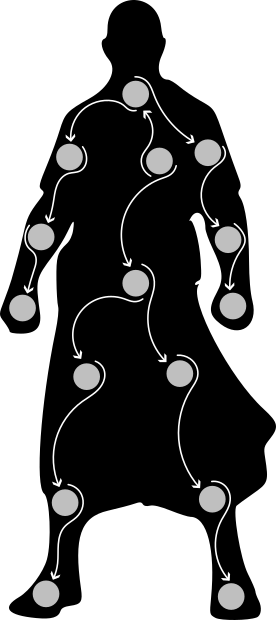
Each player character can equip powerful magical pearls. Each pearl provides a stat modifier (which scales with some affinity), an affinity bonus (which applies not only to itself but also to all other pearls “downstream” from it in the body’s energy flow), and a one-time-use magical spell that is triggered when the pearl is cracked. Cracking a pearl also permanently doubles its existing affinity bonuses, and further adds a permanent +1 darkness affinity bonus to the pearl.
There are 15 meridians of the body to which pearls can be attached:
The Heart Pearl is unique; the heart is the source of spiritual energy in the body and a pearl equipped here contributes its affinities fifteen times over: once in the heart itself, and again in every other meridian. However, the heart pearl is not influenced at all by the affinities of any other pearl, and so its magical core is the least powerful. Cracking a heart pearl can upset a luminist’s affinity balance; many luminists prefer to equip an already-cracked pearl to their heart.
The Vocal Pearl and Sacral Pearl serve as the roots of the upper and lower bodies, respectively. They both contribute their affinities sevenfold (once in their own meridian and again in each meridian in the upper and lower body), and additionally inherit the affinities of the heart pearl.
The two Superior Arm and two Superior Leg pearls divide the upper and lower body into dominant and non-dominant sides. These four pearls contribute their affinities threefold (once in their own meridian and again in each meridian further along the limb that they define). They inherit the affinities of the heart and vocal (or sacral) pearls.
The two Inferior Arm and two Inferior Leg pearls lie midway along each of the four limbs. They contribute their affinities twice (once in their own meridian and finally in the terminus of their corresponding limb). They inherit the affinities of the superior, vocal/sacral, and heart pearls. These are the pearls luminists most often crack outside battle, as their spells are made reliably powerful by the inherited affinities.
The four Terminal Pearls are located in the hands and feet. They contribute their affinities only once (to their own meridian), but they inherit more affinities than any other pearls in the body, and their spells are the most powerful. These are sometimes called the Battle Pearls, since luminists usually store their most potent and desperate spells in these meridians.
Affinity Imbalance
Generally, luminists keep their four affinities in balance. As luminists unbalance their four affinities, they gain access to strange powers, but it becomes more difficult to conceal their luminist nature.
Luminists carrying more than half their affinities in moon can always see the moonless and their skin glows faintly with moonlight. Although moon-filled luminists are effective hunters, it can be difficult for them to conceal their luminism from watchful eyes.
Luminists carrying more than half their affinities in tide can feel the surface emotions of nearby people and animals, even if they are otherwise unaware of the person’s presence. Their skin is always cool to the touch, and gravity pulls on them at a slight angle, always more toward the moon. Tide-filled luminists are excellent negotiators and investigators, but their eccentricities can betray them to their enemies.
Luminists carrying more than half their affinities in storm have superhuman reflexes and are always light on their feet. Life moves in starts and fits for them, and it’s difficult for them to judge the proper amount of motion or force to commit to fine actions, causing them to appear clumsy and reckless. Storm-filled luminists are excellent explorers and adventurers, but often troublesome in situations that call for finesse or social graces.
Luminists carrying more than half their affinities in darkness are invisible when standing in deep shadows, and their movements and things within their reach make no sounds. Even after they move away, things they touch seem muted and dim. Darkness-filled luminists are excellent infiltrators and spies, but have to rely on sign language or other methods of communication, and can inadvertently permanently drain things of their vibrance with a careless touch.
Extreme Affinity Imbalance
Although it is generally to be avoided, luminists may sometimes find it useful to put their pearls extremely out of balance. In all cases, luminists with an extreme affinity imbalance are easy to identify.
Luminists carrying more than two thirds of their affinities in moon can not only see the moonless, but touch them as well. They can also see through thin barriers (allowing them to read a letter without opening it, or spot a moonless hiding beneath clothing or in a wall). Their skin is radiant with moonlight, noticeable even in daylight, and their eyes shine like the moon.
Luminists carrying more than three quarters of their affinities in moon additionally have limited incorporeality (except to moonless and luminists who have cracked an appropriate pearl). They appear slightly translucent, and are capable of forcing their body (but not any carried nor worn materials) through any material at a slow speed.
Luminists carrying more than two thirds of their affinities in tide are no longer affected by earth’s gravity, though the moon still pulls on them weakly. With practice, and provided they’re not carrying heavy equipment, such luminists can use cloth wings to fly.
Luminists carrying more than three quarters of their affinities in tide are pulled strongly by the gravity of the moon, approximately half as much as Earth would pull. Luminists can sometimes use this to fly at incredible speeds or with heavy equipment, but must be careful to not be pulled into the sky and eventually smashed back down to Earth.
Luminists carrying more than two thirds of their affinities in storm are capable of teleporting themselves to any grounded metal object within sight. The teleportation is accompanied by a resounding thundercrack at both their origin and destination. Objects worn or held teleport with them. Such luminists must remain in constant contact with a grounded metal object if possible; if they become ungrounded they must immediately teleport.
Luminists carrying more than three quarters of their affinities in storm permanently magnetize any metals they touch. They no longer need sleep but can never will themselves to stop moving, and they electrify any water they’re in contact with.
Luminists carrying more than two thirds of their affinities in darkness are fully invisible except in direct moonlight or to other luminists who have cracked a pearl to see the moonless. However, their presence is easily noticed: they project an aura out to several meters that deepens shadows and silences all sources of noise.
Luminists carrying more than three quarters of their affinities in darkness additionally project an anti-light. Any artificial light source that touches them dims gradually until it gives no light at all. Their touch not only drains the color from objects, but permanently stills running water, kills plants, and slows heartbeats.
Battles
In combat, the player characters act as a team, and can take any number of actions in any order, interleaving them as they see fit.
Players can defeat (kills, incapacitate, or capture) an adversary if:
- The player’s clarity is equal to or greater than the adversary’s secrecy, and
- the player’s agility is equal to or greater than the adversary’s agility, and
- the player’s force is equal to or greater than the adversary’s durability.
Status Conditions
Although some weak adversaries might be defeatable right away, in most cases players will have to apply status conditions to enemies to weaken their secrecy, agility, and durability before they can defeat them.
Status conditions are measured in stacks; an adversary loses one stack of each condition at the start of the players’ turn. Each stack of a condition reduces a stat value by 75%. Multiple stacks of status conditions that reduce stats apply multiplicatively. (i.e. the final stat is 75%ⁿ, for example 75%, 56%, 42%, etc.)
Blinded reduces a character’s clarity.
Tripped reduces a character’s agility.
Weakened reduces a character’s force.
Shattered reduces a character’s durability.
Exposed reduces a character’s secrecy.
Distant is different. Instead of reducing stat values, it reduces an adversary’s contribution to the counterattack to 50% of its normal value. An adversary with one or more stacks of distant is not “nearby” and defeating them would require a ranged weapon of some kind.
Inflicting/Removing Status Conditions
When a player takes an action in combat, they describe what they are doing narratively. Each action requires a player to commit a number of stat points: a player’s stats define a per-turn “action budget”. There are three core aspects of each action:
- What status condition does the action inflict/remove? Each action applies (or removes) 1 stack of a status effect, plus one stack per 4 points of the applicable affinity.
- How is the player doing it? Their verb choice determines the applicable affinity.
- “Smash”, “shatter”, “ram”, “strike” are Storm verbs. To be successful, the player’s force must be greater than or equal to the adversary’s durability. Storm actions require 10 force and 5 durability each.
- “Trick”, “feint”, “hide”, “distract” are Darkness verbs. To be successful, the player’s secrecy must be greater than or equal to the adversary’s clarity. Darkness actions require 10 secrecy and 5 durability each.
- “Reveal”, “expose”, “warn”, “blind” (with light), “aim” are Moon verbs. To be successful, the player’s clarity must be greater than or equal to the adversary’s secrecy. Moon actions require 10 clarity and 5 durability each.
- “Bind”, “grab”, “pull”, “hold”, “move” are Tide verbs. To be successful, the player’s agility must be greater than or equal to the adversary’s agility. Tide actions require 10 agility and 5 durability each.
- What part of the body are they mostly using? This determines how much of the applicable affinity is present.
- In most cases it is assumed a player uses whatever meridian is best for the action.
For example, if a player says, “I kick the brazier over, sending a shower of hot sparks into the goon’s eyes!”, the system interprets this as a storm action that inflicts blinded. This action would only be effective on an adversary with durability lower than (or equal to) the player’s force. The action will apply at least 1 stack of blinded, and may apply more depending on how much storm affinity is present in the character’s foot (left or right, whichever has more). The action uses up (“commits”) 3 force and 1 durability from the player. This doesn’t decrease the player’s force or durability, but the player can’t use those same force or durability points for another action until the next turn.
Defeating an enemy boosts morale and momentum, which the game represents by freeing 3 stat points in every category for each player.
Counterattacks
At the end of the players’ turn, any remaining adversaries collectively make a powerful counterattack against all the players. Each adversary contributes their clarity, agility, and force to the counter-attack. The counterattack is known to the players during their turn; surviving it requires reducing it by defeating enemies or inflicting blinded, tripped, and/or weakened.
Any players defeated by the counterattack are out for the rest of the fight. So long as some players survive the battle, the defeated players survive as well (though they might need some patching up in the narrative before they can fight again). However, some rare adversaries will kill defeated players mid-battle.
Additionally, some adversaries will inflict status conditions on the players themselves.
Outcomes
Each moonless adversary in a battle is assigned a pearlescence value. Pearlescence decreases each turn, but when a moonless adversary is killed, their pearlescence is added into the battle. The greater the pearlescence, the more pearls the players will earn at the end of the battle, and the higher quality they will be.
Improvised Equipment
Luminists aren’t generally conspicuous - you’re not armed-to-the-teeth adventurers. Instead, luminists are masters of creative tactics and using their environment to their advantage. There is no mechanical benefit to using weaponry except that it may make announced actions more plausible and therefore legal. (“I punch his shield!” is not very plausible as an action that would actually inflict stacks of Shattered, but “I grab the hanging anvil and smash it into his shield!” is quite plausible.) Get creative!
Brilliant Moves
In rare cases, a player will propose an action that would so obviously be extremely effective and impossible to defend against that the GM and players will collectively declare it a brilliant move. Brilliant moves bypass the usual stat comparison requirement and will either immediately defeat the adversary, or assign double the expected number of stats.
Running Away
Not all battles can be won. A player can escape from battle if they have at least as much agility as the most agile adversary, and all adversaries have at least one stack of Distant.
Adventuring
Outside of combat, certain actions might only be possible for characters with a baseline value in a particular stat - e.g. a door can be broken in by a character with at least X force, or a cliff scaled by a character with X agility.
Character Advancement
As the campaign’s narrative progresses, players can search out and learn additional techniques to manipulate pearls and essence; these abilities are locked behind narrative gates instead of any kind of numeric level or experience points. Additionally, the players are expected to regularly gain access to additional pearls, allowing them more customization options. Not all pearls are equal - rare pearls may have stronger stats, affinities, and abilities, and some pearls will naturally form more powerful combinations with each other.--